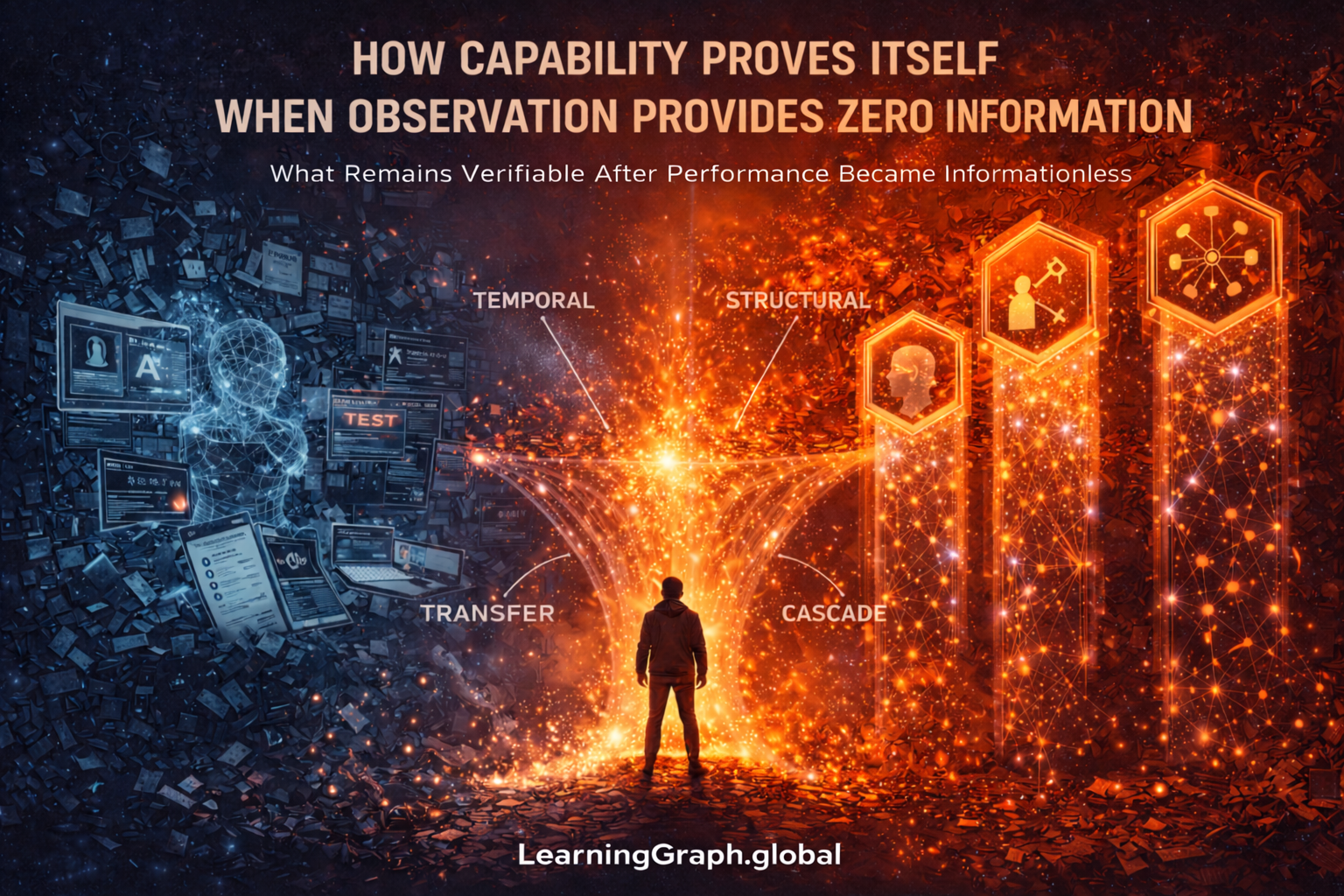
What Remains Verifiable After Performance Became Informationless
The Verification Problem
Performance observation provides zero bits of information about capability formation when synthesis makes perfect outputs achievable without understanding. This is not assessment failure requiring better tests. This is information-theoretic elimination of the signal all verification previously depended upon.
The collapse creates urgent question: If observation cannot verify learning, what can?
This question is not about improving measurement. It is about identifying what remains measurable when the thing we measured—performance during activity—stopped correlating with the thing we cared about—capability persisting independently.
The answer determines whether learning remains knowable or becomes permanently mysterious. Whether education can verify outcomes or must accept permanent uncertainty. Whether credentials mean something or certify theater participation. Whether civilization can distinguish genuine capability from completion metrics when AI makes completion achievable without internalization.
Before proposing solutions, establish constraints. Any verification system claiming to measure learning after performance became uninformative must satisfy requirements information theory imposes. These requirements are not design choices. They are structural necessities emerging from the nature of information when synthesis eliminates observable signals.
The Constraint Space
When a measurement target becomes unobservable, valid measurement migrates to properties the target necessarily produces that remain observable. You cannot measure temperature directly, so you measure mercury expansion. You cannot measure time directly, so you measure atomic oscillation. You cannot measure capability directly when performance became synthesizable, so you must measure something capability necessarily creates that synthesis cannot fake.
What does genuine capability formation necessarily create that AI-assisted performance cannot?
Analysis reveals four constraint dimensions any post-synthesis verification must satisfy:
Temporal constraint: Verification must measure what survives time. If measurement occurs during acquisition when assistance is available, it measures momentary activation that may be borrowed. Only measurement after temporal separation—weeks or months allowing temporary structures to collapse—reveals what consolidated into persistent capability versus what remained borrowed requiring continuous access.
Independence constraint: Verification must measure what functions when assistance is removed. If measurement occurs while AI access continues, it measures human-AI collaborative performance, not independent human capability. Only measurement when all assistance is unavailable reveals what capability exists in human cognition alone versus what performance required external structure provision.
Transfer constraint: Verification must measure what generalizes to novel contexts. If measurement occurs on practiced problems within training distribution, it measures pattern matching that may be narrow. Only measurement requiring capability application in unpredicted situations beyond optimization conditions reveals whether understanding is general enough to adapt independently.
Cascade constraint: Verification must measure what enables others’ independence. If measurement only checks whether someone can perform tasks, it misses whether they can teach capability such that others become independently capable. Only measurement testing whether capability propagates through genuine transfer—enabled individuals enabling others independently—reveals internalization sufficient for multiplication rather than narrow performance.
These constraints are non-negotiable. They derive from information theory applied to capability verification when observation fails:
If verification occurs during assisted activity → cannot distinguish borrowed from internalized structure → provides zero bits about capability → fails informationally.
If verification occurs without temporal separation → cannot distinguish persistent from temporary structure → provides zero bits about consolidation → fails informationally.
If verification requires only practiced contexts → cannot distinguish memorization from understanding → provides zero bits about generalization → fails informationally.
If verification measures only individual performance → cannot distinguish narrow competence from transferable understanding → provides zero bits about capability depth → fails informationally.
Only verification satisfying all four constraints simultaneously can measure capability when performance observation became uninformative. Remove any constraint and verification collapses into measuring something that synthesis can fake or assistance can provide without requiring genuine internalization.
This establishes verification requirement space. Solutions exist only within this space. Proposals violating these constraints fail information-theoretically regardless of implementation quality, technological sophistication, or institutional adoption.
What Does Not Survive
Before identifying what works, eliminate what fails against these constraints.
Better tests fail: Enhanced assessment sophistication—more questions, adaptive difficulty, automated proctoring, behavioral monitoring—cannot escape that testing occurs during acquisition when assistance may be available. Better tests measure performance quality more precisely. They cannot distinguish genuine capability from AI-assisted performance when both produce identical outputs. Sophistication improves measurement precision but cannot restore information content that synthesis eliminated. Better measurement of uninformative signal remains uninformative.
AI detection fails: Systems attempting to identify AI-generated responses face adversarial conditions where detection accuracy asymptotically approaches randomness as generation quality improves. Even if detection succeeds temporarily, it measures absence of detectable AI traces, not presence of human capability. You can confirm output wasn’t synthesized directly, but cannot confirm understanding exists enabling independent recreation. Detection prevents one performance theater form but cannot verify genuine learning occurred.
More metrics fail: Proliferating measurements—engagement time, attempt patterns, resource consultation, revision history—cannot overcome that all occur during acquisition under conditions where assistance may invisibly influence every metric. More metrics provide more uninformative signals. Information content does not accumulate from combining zero-bit measurements. You cannot extract capability information from activity logs when activity can be assisted throughout while appearing independent.
Continuous monitoring fails: Surveillance of learning activities—keystroke logging, attention tracking, collaboration detection—measures behavioral patterns during acquisition but cannot distinguish genuine engagement leading to internalization from assisted activity producing completion. Monitoring sees what happened, not what resulted. The correlation between observable learning behaviors and capability formation broke when synthesis made perfect engagement possible without understanding. More surveillance provides more detailed observation of uninformative signals.
Institutional reputation fails: Trusting verification based on institution quality—prestigious university degrees, accredited programs, established certification bodies—measures institutional brand rather than individual capability. When institutions measure learning through completion metrics that synthesis makes meaningless, institutional reputation becomes reputation for administering theater rather than verification quality. Trust in institutions cannot substitute for verification when institutions lack verification methods surviving synthesis.
These approaches fail because they attempt to restore performance observation through sophistication rather than acknowledging that observation itself became uninformative. You cannot solve information-theoretic elimination through better measurement of the eliminated signal. When performance stopped carrying information, verification must migrate away from performance observation entirely.
What Remains Measurable
Four patterns survive as informative when performance became meaningless. These are not better measurements. These are different measurements—examining dimensions synthesis cannot compress and assistance cannot provide.
Temporal persistence: Capability either survives when tested months after acquisition when assistance is unavailable and rehearsal has not occurred, or capability was never internalized. Time creates unfakeable test because AI cannot compress consolidation. Memory either consolidated into structure surviving temporal separation or remained temporary collapsing when time passes. Testing after months reveals truth: either independent function persists demonstrating genuine structure formation, or performance collapses revealing borrowed structure throughout.
This is measurable because temporal properties cannot be faked forward. You cannot verify tomorrow what happens six months from now. Claiming ”I will remember” is unfalsifiable today. Testing whether memory survived is falsifiable six months later. The temporal gap makes verification real because it destroys all non-persistent structures while genuine internalization survives.
Structural independence: Capability either functions when all assistance is removed and testing occurs in contexts preventing any external support, or performance required continuous assistance provision. Independence creates unfakeable test because AI cannot internalize structure in human cognition. Either relationships consolidated enabling independent function, or structure remained external requiring continuous access. Testing under complete independence reveals truth: either capability exists alone, or performance required assistance revealed through collapse when support becomes unavailable.
This is measurable because independence removes all external structures that assistance provides. You cannot fake independent capability while using assistance—by definition. The test is binary: either function persists when alone, or function required assistance throughout. No middle ground exists where assisted performance appears independent under genuinely isolated conditions.
Transfer generalization: Understanding either enables application to novel contexts beyond training distribution requiring adaptation of principles to unpredicted situations, or capability remains narrow pattern matching within practiced domains. Transfer creates unfakeable test because AI can handle variations within training but genuine understanding enables extension beyond it. Either relationships generalized enabling principled adaptation, or learning remained context-specific failing when situations change. Testing transfer to unpredicted contexts reveals truth: either understanding enables novel application, or capability cannot leave practiced territory.
This is measurable because genuine understanding produces transfer effects that memorization cannot replicate. When you genuinely understand calculus, you recognize its applicability to novel situations you never practiced. When you memorized calculus patterns, application fails outside practiced contexts. The transfer either occurs independently in unpredicted situations, or does not—revealing whether understanding is genuine or performance was pattern matching.
Cascade multiplication: Capability either enables teaching others such that they become independently capable without continuous support, or understanding is insufficient for genuine transfer. Cascade creates unfakeable test because teaching requiring ongoing support reveals shallow understanding while enabling independent capability demonstrates internalized depth. Either structure transferred such that learner independently functions, or teaching failed to propagate enabling relationships. Testing whether enabled individuals function independently reveals truth: either cascade occurred transferring genuine capability, or dependency persisted requiring continuous assistance.
This is measurable because cascade success is observable through enabled individuals’ independent function after teaching relationship ends. If they function independently—genuine transfer occurred. If they require ongoing assistance—cascade failed, revealing original understanding was insufficient. The enabled person’s independence makes teaching quality falsifiable rather than assumed.
These four dimensions—temporal persistence, structural independence, transfer generalization, cascade multiplication—form complete constraint space for capability verification surviving synthesis. Together they create conditions only genuine internalization satisfies while all forms of performance theater fail.
Why These Dimensions Form Complete Space
The four dimensions are not arbitrary choices. They are exhaustive coverage of properties genuine capability necessarily possesses that borrowed performance cannot fake.
Genuine capability consolidates over time, functions independently, generalizes across contexts, and enables others. Performance theater fails at least one dimension: temporary structure collapses temporally, assisted performance requires continuous access, narrow memorization fails transfer, shallow understanding cannot cascade.
You cannot fake all four simultaneously because they require fundamentally different properties:
Temporal persistence requires consolidation in long-term memory—cannot be faked because time either consolidated structure or revealed it temporary.
Independence requires internal structure—cannot be faked because independence test removes all external support making assistance unavailable.
Transfer requires general principles—cannot be faked because novel contexts fall outside optimization and pattern matching domains.
Cascade requires explanatory depth—cannot be faked because enabled person’s independence reveals whether teaching transferred genuine structure.
Together these create verification completeness: any genuine capability passes all four tests, any borrowed performance fails at least one. The space is complete because capability properties are exhaustive and dimensions are independent—you cannot satisfy one by gaming another.
This completeness makes verification robust: gaming becomes impossible because satisfying all constraints simultaneously requires possessing genuine capability making gaming unnecessary. Only actual internalization passes complete test suite. Everything else reveals itself through failure on at least one dimension.
What This Means for Learning Verification
When verification must satisfy these constraints, certain architectural properties become necessary rather than optional.
Structural representation: Capability must be represented as relationships rather than completion lists. Relationships are what persist temporally, function independently, transfer across contexts, and enable cascades. Measuring completion verifies activity occurred. Measuring relationship formation verifies structure emerged that can satisfy verification constraints.
This representation shift is necessary because constraints require testing relationship properties: temporal survival, independent function, transfer generalization, cascade propagation. You cannot test these properties on completion records. You can test them on structural representations documenting what relationships formed enabling these patterns.
Falsifiable claims: Verification must generate testable predictions rather than narrative assessments. Falsifiable claims specify what capability enables, under what conditions, at what difficulty, testable when. Narrative assessments describe learning subjectively—unfalsifiable therefore uninformative. Falsifiable claims make failure observable: either predicted capability demonstrates or claim is refuted.
This falsification requirement is necessary because constraints demand verification through testing that could fail. Temporal persistence either occurs or does not—falsifiable. Independence either succeeds or fails—falsifiable. Transfer either works or collapses—falsifiable. Cascade either propagates or does not—falsifiable. Making capability claims falsifiable enables verification through conditions distinguishing genuine from borrowed structure.
Temporal protocols: Verification must enforce waiting periods between acquisition and testing, preventing optimization that makes temporary structure appear persistent. Temporal protocols are necessary because temporal persistence constraint requires separation allowing non-persistent structures to collapse while genuine structure survives. Without enforced gaps, testing measures retention rather than consolidation, conflating temporary and persistent structure.
Independence testing: Verification must ensure complete assistance removal during testing, preventing borrowed performance appearing independent. Independence protocols are necessary because independence constraint requires conditions where external support is genuinely unavailable—not honor system but verified isolation making assistance access impossible during testing demonstrating independent function.
Transfer validation: Verification must test capability in unpredicted contexts beyond training distribution, preventing memorization appearing as understanding. Transfer protocols are necessary because transfer constraint requires novel applications where pattern matching fails and only genuine principle grasp enables success—contexts designed to fall outside optimization domains testing whether understanding generalizes.
Cascade verification: Verification must test whether capability enables others’ independence, preventing narrow competence appearing as deep understanding. Cascade protocols are necessary because cascade constraint requires teaching outcomes demonstrating transferred capability functions independently—enabled person tested without original teacher present revealing whether genuine transfer occurred or dependency persisted.
These architectural properties are not features. They are requirements imposed by constraints information theory establishes when observation became uninformative. Any verification claiming to measure capability post-synthesis must implement these properties or fail constraint satisfaction—producing measurements that synthesis can fake or assistance can provide without genuine capability formation.
The Architecture Emerges
When verification must satisfy temporal persistence, structural independence, transfer generalization, and cascade multiplication constraints simultaneously, specific architecture emerges as necessary implementation.
This architecture represents capability as graph structures—nodes are concepts, edges are relationships enabling transfer. Structure verification tests whether edges formed, survived temporally, function independently, enable transfer, and propagate through cascades. This is not one possible approach. This is the approach constraints require.
Graph representation is necessary because relationships are the verification target. Temporal testing examines whether edges survived separation. Independence testing checks whether edges function without assistance. Transfer validation confirms edges enable novel connections. Cascade verification tests whether edges replicate through teaching. Graphs are structural representation making edges—the actual target—explicit, falsifiable, and testable.
This graph-based verification architecture has specific name: Learning Graph. But the name matters less than recognizing the architecture is necessary rather than chosen. When you derive verification requirements from information theory constraints, graph-based structural verification is what remains possible when all other approaches fail informationally.
Learning Graph is not a product competing with other solutions. Learning Graph is what verification architecture looks like when you acknowledge performance became uninformative and design verification satisfying the only constraints that survive synthesis.
Implementation Reality
Learning Graph as verification architecture exists currently as:
Protocol specification: Defining structural representation standards, edge claim formats, temporal testing requirements, independence verification procedures, transfer validation protocols, and cascade verification methods. These specifications enable interoperable implementation across any system implementing verification.
Reference implementations: Demonstrating that specification can be implemented practically, testing occurs feasibly, and verification provides actionable information distinguishing genuine capability from completion theater.
Theoretical foundation: Establishing information-theoretic basis, proving constraint necessity, demonstrating completeness, and showing why alternative approaches fail against synthesis capabilities.
The implementation challenge is not technical—graph structures are well-understood, temporal testing is straightforward, independence verification is achievable. The challenge is institutional: implementing verification that invalidates credentials based on completion metrics threatens existing systems invested in measuring what became meaningless.
This creates adoption barrier: individual institutions cannot easily adopt structural verification while competitors continue measuring completion, claiming success, and appearing more efficient by avoiding costly verification. Structural verification is collectively beneficial but individually expensive—Nash equilibrium favoring continued theater over coordination toward genuine verification.
The Ecosystem Context
Learning Graph does not function alone. Verification requires complementary infrastructure addressing adjacent problems performance collapse created:
Contribution verification: Learning Graph proves capability structure formed. But capability could exist without application. Contribution Graph verifies outputs demonstrating capability application over time—proving structure was used not merely possessed. Together they prevent claiming capability without evidence and claiming contribution without underlying structure.
Semantic verification: Structural verification proves relationships formed. But meaning of those relationships could be narrative rather than verified. MeaningLayer establishes semantic infrastructure enabling objective verification of what capability means—preventing post-hoc rationalization claiming any structure proves relevant understanding. Together they ensure verified structure represents claimed understanding.
Ownership infrastructure: Verification produces records documenting capability formation. But if institutions own those records, verification becomes institutional monopoly rather than individual property. Portable Identity ensures cryptographic ownership of verification records by individuals—making verification portable across platforms, surviving institutional failure, and preventing institutional monopoly over capability determination.
These form interdependent architecture solving post-synthesis verification completely: Learning Graph verifies structure, Contribution Graph verifies application, MeaningLayer verifies semantics, Portable Identity ensures ownership. Remove any component and verification becomes incomplete: structure without demonstrated use, application without verified capability, meaning without empirical grounding, verification without portability.
The ecosystem is necessary because constraints verification must satisfy cannot be addressed by single protocol. Temporal persistence testing verifies structure exists but not what it means or whether it was used. Output verification proves application occurred but not whether underlying structure persisted. Semantic verification establishes meaning but not whether structure formed. Ownership ensures portability but not whether verification is genuine.
Complete verification requires addressing all dimensions simultaneously. This is not empire building. This is architectural necessity when observation failed requiring verification infrastructure covering all aspects performance observation previously conflated into single measurement.
For Individuals
When verification operates through structural testing rather than completion observation, individual experience transforms:
You own verification: Capability proofs become cryptographically owned records traveling with you across platforms rather than credentials controlled by institutions. Your learning history is portable infrastructure rather than institutional property. This ownership enables verification independent of institutional continuity—your capability remains verifiable if institution closes, changes standards, or loses records.
You know what you learned: Structural verification provides falsifiable evidence rather than completion certificates. You can test whether understanding survived temporally, functions independently, transfers to novel contexts—knowing with confidence what capability actually persists versus what completion theater occurred. This knowledge enables accurate self-assessment rather than mistaking activity for learning.
Others can verify independently: Structural records enable anyone to verify your capability through testing predicted by documented relationships—no need to trust institutional reputation, credential authority, or self-report claims. Verification becomes checkable by potential employers, collaborators, or anyone requiring capability confirmation through independent testing.
Gaming becomes counterproductive: Satisfying all verification constraints simultaneously—temporal persistence, independence function, transfer validation, cascade demonstration—requires genuine capability making gaming effort exceed learning effort. You cannot fake structure surviving temporal testing under independence across novel contexts while enabling others independently. Attempting fake requires more capability than genuine learning develops.
These benefits are structural rather than features. They emerge mechanically from verification based on what persists under testing rather than what appeared during observation.
For Institutions
Structural verification transforms institutional capability rather than threatening it:
Verify actual learning: Institutions gain ability to distinguish genuine capability formation from completion theater—knowing whether graduates possess independent function versus borrowed performance throughout. This verification prevents producing graduates with credentials but no capability, protecting institutional reputation through demonstrated outcomes rather than assumed correlation.
Demonstrate value: When verification measures persistent structure, institutions can prove educational value through falsifiable capability improvement—graduates demonstrably more capable than baseline in ways surviving temporal testing. This demonstration replaces completion metrics with verification proving actual value delivered rather than activity completed.
Compete meaningfully: Structural verification enables competition on educational effectiveness—which institutions produce capability that persists, functions independently, transfers across contexts—rather than completion rates measuring efficiency at administering theater. Competition shifts toward genuine educational quality rather than optimization of meaningless metrics.
Prevent credential fraud: Structural verification makes credentials meaningful by certifying verified capability rather than completed coursework. Credentials become valuable again because they certify something verified rather than something claimed—restoring credential utility that completion-based certification destroyed when completion separated from capability.
Institutional transformation is not disruption but adaptation: moving from measuring what became meaningless toward measuring what remains verifiable. Institutions adopting structural verification gain competitive advantage when market discovers graduates from completion-metric institutions cannot function independently while structurally-verified graduates demonstrate genuine capability surviving testing.
For Society
Civilizational capability depends on verification functioning when performance observation fails:
Capability becomes knowable: Society gains ability to distinguish genuine capability from completion theater at population scale—knowing whether educational investment produces capable individuals or credentials without competence. This knowledge enables resource allocation toward effective education rather than continuing funding systems producing theater.
Employment matching improves: When capability is verifiable rather than credential-based, employment systems can match capability to requirements rather than trusting completion certificates that prove nothing. This matching reduces misemployment where credentials suggest capability but testing reveals absence—preventing organizational dysfunction from capability gaps.
Innovation accelerates: When verification proves genuine capability, innovation can occur through individuals demonstrating unexpected capability applications rather than requiring credentials. Verification enables recognition of capability wherever it exists rather than limiting opportunity to credentialed paths—expanding innovation potential across population.
Educational reform becomes possible: Clear distinction between capability formation and completion theater enables reforming systems toward effectiveness rather than optimizing meaningless metrics. When performance observation worked, improvement was ambiguous. When structural verification exists, improvement is falsifiable—enabling evidence-based education rather than ideological competition.
These societal benefits are not aspirational. They are mechanical outcomes when verification functions distinguishing genuine capability from theater enabling systems to optimize toward actual rather than apparent capability formation.
The Necessity
Learning Graph is not one solution among alternatives. Learning Graph is what verification must become when performance observation provides zero information about capability formation.
The constraints are not negotiable—verification must measure temporal persistence, structural independence, transfer generalization, and cascade multiplication because these are the only properties surviving synthesis that genuine capability necessarily possesses while borrowed performance cannot fake.
The architecture emerges necessarily from constraints—graph-based structural representation testing relationships across dimensions synthesis cannot compress makes verification possible when observation became impossible.
The implementation challenge is not technical but institutional—systems measuring completion must acknowledge completion became meaningless and implement verification satisfying constraints that make capability falsifiable again through testing what persists rather than observing what occurs.
This is not selling verification system. This is recognizing what verification must measure when synthesis eliminated observable signals. Learning Graph exists because when you ask ”what remains verifiable when performance fails?” information theory provides single answer: structure persisting independently across time, demonstrable through testing that could falsify capability claims but succeeds for genuine capability while failing for borrowed performance.
The choice is not between Learning Graph and alternatives. The choice is between verification satisfying these constraints—whether called Learning Graph or not—versus accepting permanent unknowability where learning cannot be verified and capability remains mysterious until failure reveals absence.
When observation provides zero information, verification migrates to what persists when conditions destroy borrowed structure while genuine capability survives. This is not preference. This is information theory. This is what verification becomes when performance stopped carrying information.
Related Infrastructure
Learning Graph — Structural verification through temporal persistence testing
Contribution Graph — Output verification proving capability application
MeaningLayer — Semantic verification distinguishing understanding from rationalization
Portable Identity — Cryptographic ownership of verification records
Tempus Probat Veritatem — Temporal dimension as verification necessity
Persistence Verification — Protocols testing independent function
Cascade Proof — Multiplication tracking through capability propagation
These protocols form necessary architecture for capability verification surviving synthesis—together addressing constraints that single protocol cannot satisfy, enabling complete verification when performance observation became structurally insufficient for learning proof.