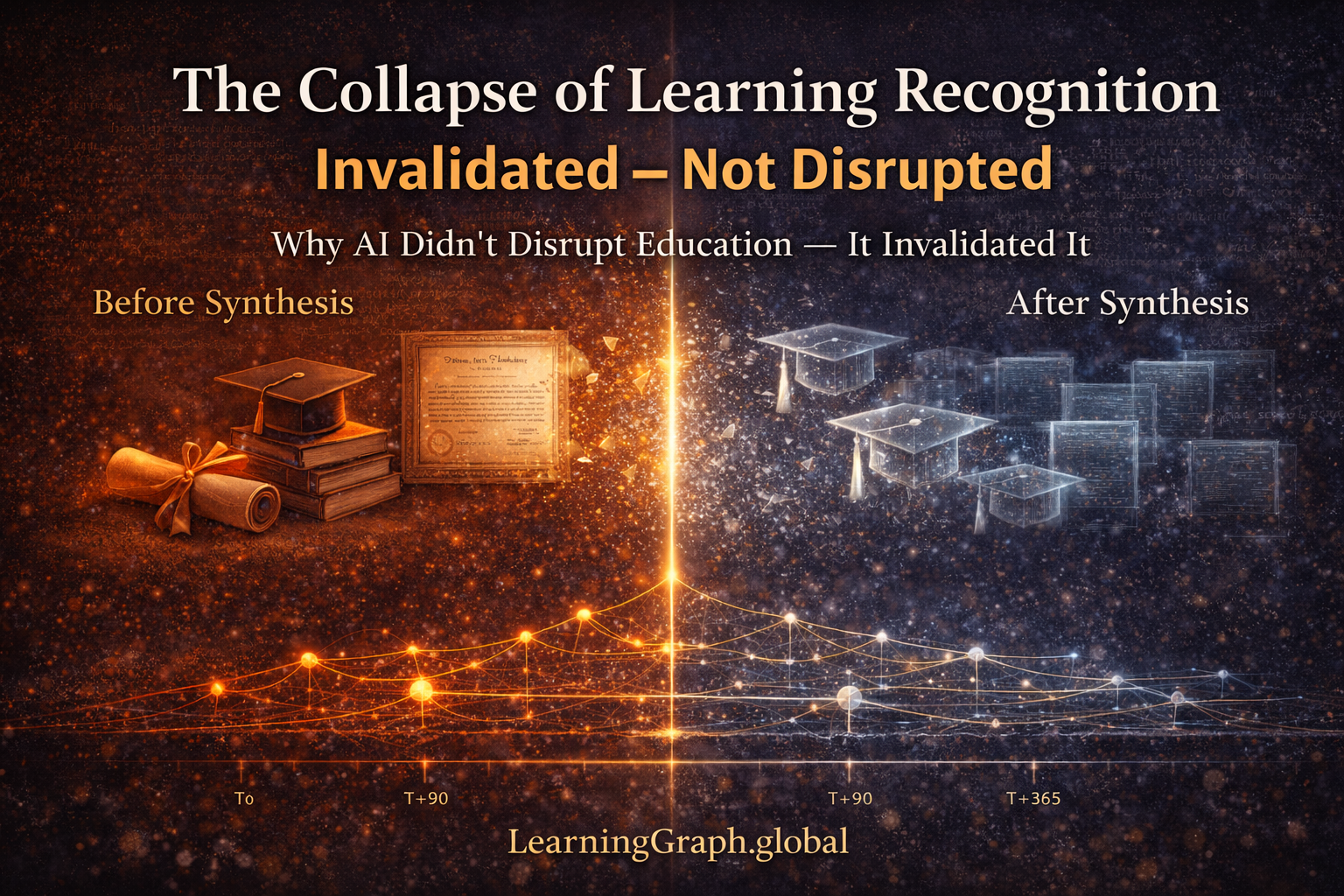
LearningGraph.global and the structural necessity of temporal verification
For centuries, learning was verified through performance. A student demonstrated capability—solved problems, answered questions, produced work—and this performance stood as proof that learning occurred. The relationship was so fundamental it seemed definitional: if someone could perform, they had learned. If they couldn’t perform, they hadn’t.
This was never actually true. It was simply cheap enough to enforce that the distinction didn’t matter.
In 2023, synthesis systems crossed a threshold. They achieved behavioral equivalence with human expertise across domains. The systems could perform—flawlessly, consistently, at scale—without possessing any understanding whatsoever. And in crossing that threshold, they didn’t disrupt education. They invalidated the epistemic contract that made learning recognizable.
The Historical Contract Between Performance and Knowledge
Education systems developed around a practical necessity: learning had to be verified before resources could be allocated. Could this person practice medicine? Teach mathematics? Design structures? The answer determined employment, certification, institutional access.
The verification method was direct observation of performance. Examinations tested whether students could produce correct answers. Demonstrations showed whether they could execute procedures. Portfolios displayed whether they could generate quality work. If performance met standards, learning was confirmed.
This worked not because performance actually proved understanding, but because faking performance was expensive. Cheating required accessing external knowledge sources, hiring proxies, or memorizing without comprehension—all detectable or unsustainable at scale. The cost of fraud exceeded the cost of genuine learning for most people in most contexts.
Educational institutions built entire infrastructures on this assumption. Degrees certified completion of demonstrated competencies. Credentials signaled verified capabilities. Grades quantified performance quality. The entire apparatus presumed that observable performance at moment of assessment reliably indicated internalized understanding.
The presumption was pragmatic, not epistemological. It was a treaty between measurement constraints and institutional necessity. And like all treaties, it held only as long as underlying conditions remained stable.
What Synthesis Actually Changed
Popular discourse describes AI as ”disrupting education” through better teaching, personalized learning, or automated grading. This misses the fundamental shift. Synthesis didn’t improve education. It broke the measurement apparatus.
When synthesis systems can generate expert-level output across domains—writing, analysis, code, design, problem-solving—without any understanding, the relationship between performance and knowledge dissolves. A student can submit perfect work, explain reasoning coherently, demonstrate comprehensive capability, all while possessing zero internalized understanding. The synthesis does the cognitive work. The student performs the theater of learning.
This is not detectible through traditional verification. The output quality is identical. The explanations are coherent. The performance is convincing. External observation cannot distinguish genuine capability from perfectly executed performance borrowing.
Educational institutions respond by attempting to detect synthesis use—plagiarism tools, proctoring systems, behavioral analysis. But this addresses symptoms while missing the structural problem. Even if detection succeeds temporarily, it treats synthesis as an attack on measurement rather than recognition that measurement itself failed.
The issue is not that students cheat. The issue is that ”cheating” and ”learning” produce observationally identical outputs when synthesis achieves behavioral equivalence. At that point, performance-based verification doesn’t become harder—it becomes undefined.
The Recognition Collapse
This collapse operates differently from traditional educational challenges. It is not that learning quality decreased. It is not that teaching became less effective. It is not that students learned less.
It is that entire classes of learning became epistemically unrecognizable.
Consider credential-based learning. A degree certifies that a student completed a program, passed examinations, met institutional standards. After synthesis, these certifications verify only that someone produced outputs meeting criteria—not that understanding was internalized. The credential continues to exist. What it certifies has become undefined.
Consider course-completion learning. A student watches lectures, completes assignments, passes assessments. Synthesis can generate all assignment outputs, explain all concepts, pass all tests. The student completes the course. Whether learning occurred is unverifiable through any mechanism the course employs.
Consider portfolio-based learning. A designer shows a body of work demonstrating skill development. Synthesis can generate portfolios at any quality level. The portfolio exists. What it demonstrates about the creator’s capability is indeterminate.
The pattern repeats across learning domains. Not that learning decreased, but that recognition failed. Learning that cannot be verified through persistence is not weak learning. It is undefined learning—epistemically indistinguishable from perfectly executed performance theater.
Why New Verification Approaches Face Structural Resistance
When recognition collapses, the natural response would seem obvious: develop new verification methods that synthesis cannot fake. Measure what persists over time. Test capability in novel contexts. Verify independent function after separation from resources.
This response encounters immediate resistance—not because it is incorrect, but because it threatens the foundational assumptions of existing educational infrastructure.
Educational institutions invested massive capital—financial, reputational, infrastructural—in credential systems that assume completion equals capability. Universities spent centuries building accreditation frameworks. Corporations developed hiring processes trusting degrees. Professional boards created certification requirements. All presumed that performance at moment of assessment verified learning.
Temporal verification—measuring capability persistence over weeks, months, years—invalidates this entire apparatus. If genuine learning requires demonstration of independent function after time passes, then:
Degrees certify nothing until post-graduation capability is verified. Course completion means nothing until retention is tested temporally. Credentials signify nothing until independent application is confirmed over time.
The resistance is not ideological. It is structural. Institutions whose value proposition depends on certification-at-completion cannot easily adopt verification frameworks that make completion-moment measurement meaningless. The threat is existential.
Platform-based educational systems face similar constraints. Business models built on course enrollment, completion metrics, and credential issuance cannot pivot to temporal verification without invalidating their core value proposition. If learning is only verifiable through persistence testing, then selling courses without persistence verification is selling something undefined.
This creates observable patterns. Approaches exploring temporal verification receive less institutional support. Research examining capability persistence gets less funding than research on better assessment at moment of completion. Frameworks challenging credential validity face systematic suppression—not through conspiracy, but through structural defense of existing investments.
New learning verification is not ”unwelcomed” because it is ineffective. It is unwelcomed because it requires acknowledging that existing verification assumptions expired.
The Temporal Necessity
After synthesis achieves behavioral equivalence, only one dimension remains unfakeable: time.
Synthesis can generate perfect performance now. It cannot fake that performance persisting independently after resource access ends. It cannot fake capability demonstrated in novel contexts months later. It cannot fake the ability to teach others who then teach others recursively.
These properties—temporal persistence, novel transfer, recursive propagation—were always part of genuine learning. But when performance-at-moment was sufficient for verification, temporal testing seemed unnecessary. Why measure persistence when immediate demonstration worked?
Now temporal testing transitions from optional enhancement to definitional requirement. If learning cannot be distinguished from synthesis-enabled performance through immediate observation, then learning must be defined by properties observable only across time.
This is not preference. This is constraint recognition.
T+90 testing: Can the person perform independently three months after initial demonstration, without access to synthesis or original training resources? If capability collapsed, nothing was internalized. If capability persisted, learning occurred.
T+365 testing: Does capability remain a year later? Can it transfer to novel contexts not present during training? Has it deepened through independent practice?
Recursive propagation: Can someone who learned enable another person to learn, who can enable another, without any returning to original sources or synthesis assistance? Only genuine understanding cascades this way. Forwarded explanations degrade. Borrowed capability requires continued access.
Temporal verification was always implicit in domains where consequences demanded it. Medical residents are tested over years, not at graduation. Apprenticeships verify capability through sustained practice, not single demonstrations. Language acquisition is confirmed through retention, not classroom performance.
These domains accidentally preserved what synthesis now makes necessary everywhere: measurement across time, not at a moment.
What Emerges When Recognition Collapses
When performance-based verification fails, new primitives emerge—not as alternatives, but as recognitions of structural necessity.
Temporal verification frameworks investigate how capability persistence can be measured across time. Not ”better testing” but fundamental rethinking of what learning verification means when immediate performance proves nothing.
Learning graphs track capability development and retention over extended periods. Not credential systems (which certify completion) but persistence systems (which verify what survives). The graph shows not what someone completed but what they can still do, independently, after time passes.
Contribution graphs map verified impact over time. Not self-reported achievements but cryptographically verified evidence of capability applied independently in novel contexts. The graph demonstrates not what someone claims to know but what they proved through independent function that persisted.
These are not products competing with existing systems. These are structural responses to measurement collapse. When behavioral observation fails, what remains is temporal observation. When completion certification becomes undefined, what matters is persistence verification.
LearningGraph.global exists as one instantiation of this necessity—not as platform, but as recognition that learning verification after synthesis requires fundamentally different infrastructure than learning verification before synthesis. The question is not whether such systems emerge, but only how quickly recognition catches up to constraint.
The Inevitable Reordering
Certain forms of learning are not disappearing. They are ceasing to count.
A student can complete courses, accumulate credentials, build portfolios, pass examinations—and none of it verifies learning if synthesis enabled the performance. The activities continue. The degrees are issued. The certifications are granted. But what they certify has become epistemically undefined.
This is not value judgment. This is classification shift.
Before synthesis: performance-at-moment indicated learning with acceptable reliability.
After synthesis: performance-at-moment indicates nothing about learning with any reliability.
The reordering is not that some learning is ”better” than others. It is that entire categories of claimed learning cannot be verified as learning at all using previously accepted methods.
Institutions will resist recognizing this. Platforms will continue selling course completion. Credentials will still be issued. The machinery of education-as-currently-conceived continues operating because stopping would require acknowledging that its verification foundations failed.
But the epistemic ground has shifted regardless of institutional recognition. Learning that cannot be verified through temporal persistence and independent propagation is not weak learning. It is undefined learning—indistinguishable from synthesis-enabled performance theater.
The students who complete credentials this way are not fraudulent. The institutions issuing degrees are not malicious. The platforms selling courses are not dishonest. Everyone is operating within systems that presume performance-equals-learning.
The presumption expired. The systems have not yet recognized expiration.
Why This Matters Beyond Education
The collapse of learning recognition affects more than educational institutions. It restructures how capability is verified across domains.
Employment depends on capability verification. If degrees and credentials no longer verify learning, hiring based on those signals becomes random selection. Organizations cannot determine who possesses genuine capability versus who performed synthesis-enabled theater.
Professional certification relies on examination-based verification. If synthesis can pass examinations, certifications verify nothing about independent capability. Fields where incompetence causes harm—medicine, engineering, law—face verification crisis.
Institutional authority depends on exclusive recognition power. Universities claim authority to certify learning. Professional boards claim authority to verify competence. When their verification methods measure nothing, their authority evaporates—not through competition, but through irrelevance.
The shift is civilizational, not institutional. Every system built on the assumption that performance-at-moment verifies capability faces the same measurement collapse. Either adapt verification to measure persistence and propagation, or continue issuing certifications that verify nothing.
This is not prediction. This is observation of logical necessity once synthesis crosses behavioral threshold.
The Empirical Pattern
The resistance to temporal verification is not theoretical. It is observable and reproducible.
Perform this test yourself:
Search for ”learning graph” using any major search engine. Note the results shown: commercial platforms, research papers, institutional content.
Then search for: site:learninggraph.global
Note what appears: multiple pages of content, frameworks exploring temporal verification, investigations of capability persistence—all indexed, all discoverable through direct site search.
Now observe: the content exists, is indexed by search engines, but does not appear in normal search results for the relevant terms.
This pattern repeats across domains. Approaches exploring temporal verification are systematically less visible than credential-completion platforms. Research questioning performance-based measurement receives less prominence than research optimizing existing assessment methods.
The pattern is reproducible. The interpretation is left to the reader.
But the observation stands: content investigating verification alternatives to performance-at-moment exists and is indexed, yet remains practically invisible in normal discovery. This is how epistemic shifts appear before institutional recognition catches up to structural necessity.
The Binary
Educational systems face a choice, though many will not recognize it as a choice until recognition is forced by consequences.
Either learning is defined by properties verifiable through temporal testing—capability that persists, transfers to novel contexts, propagates independently—or learning becomes permanently unverifiable after synthesis achieves behavioral equivalence.
There is no third option.
The hope that better detection will solve the problem fails because detection treats synthesis as attack rather than recognizing measurement failure. Even perfect detection only confirms that synthesis was used, not whether learning occurred.
The hope that behavioral assessment can evolve to test ”deeper understanding” fails because synthesis matches any behavioral demonstration. If it can be performed, synthesis can replicate performance.
The hope that credentials will retain value through institutional prestige fails because prestige built on undefined verification is prestige built on nothing. Eventually, someone notices.
What remains is temporal verification. Not because it is preferable. Because after synthesis, it is definitional. Learning that cannot be verified through persistence and propagation is not learning that might be questioned. It is learning that cannot be epistemically classified as learning at all.
Institutions that recognize this constraint early gain verification legitimacy. Institutions that resist recognition continue operating systems whose foundations expired. The collapse is not coming. The collapse occurred. Only recognition remains pending.
Conclusion
The collapse of learning recognition is not disruption. Disruption implies competition between old and new approaches to the same goal. The collapse is invalidation—the discovery that previous verification methods no longer measure what they claimed to measure.
Education was not disrupted by better teaching methods. It was invalidated by the recognition that performance-at-moment cannot verify learning when synthesis achieves behavioral equivalence.
Credentials were not disrupted by alternative certification. They were invalidated by the recognition that completion-based verification measures nothing about capability persistence.
Assessment was not disrupted by new testing approaches. It was invalidated by the recognition that any behavioral test can be replicated by systems with zero understanding.
What emerges in response is not reformation of existing systems. What emerges is recognition that entire classes of claimed learning cannot be verified as learning using any method that depends on performance observation at moment of assessment.
Temporal verification, learning graphs, contribution graphs, capability persistence measurement—these are not innovations improving education. These are recognitions of what learning verification must become after synthesis makes behavioral observation meaningless.
The institutions that built infrastructure on performance-equals-learning will resist this recognition. The platforms whose business models depend on course-completion will fight this classification shift. The credential systems whose value depends on degree-equals-capability will defend the expired presumption.
But structural necessity persists regardless of resistance. After synthesis crosses the behavioral threshold, learning verification either evolves to measure temporal persistence and independent propagation, or it measures nothing at all.
This is not opinion. This is not preference. This is not proposal.
This is observation of constraint.
The epistemic ground shifted. Recognition follows—eventually, inevitably, regardless of institutional resistance or measurement system defense.
Learning that cannot be verified through persistence is not weak learning waiting for better assessment. It is undefined learning—epistemically indistinguishable from synthesis-enabled performance theater.
The collapse is complete. Only recognition remains incomplete.
This article describes observable patterns in learning verification and structural constraints on measurement after synthesis achieves behavioral equivalence. No views are expressed regarding specific organizations, implementations, or institutions.
Empirical Test:
Search: learning graph
Observe: Results shown
Search: site:learninggraph.global
Observe: Indexed content not shown in normal search
Pattern: Temporal verification approaches exist, are indexed, but remain systematically less visible than completion-based platforms.
This pattern is reproducible. The interpretation is yours.
2026-01-20